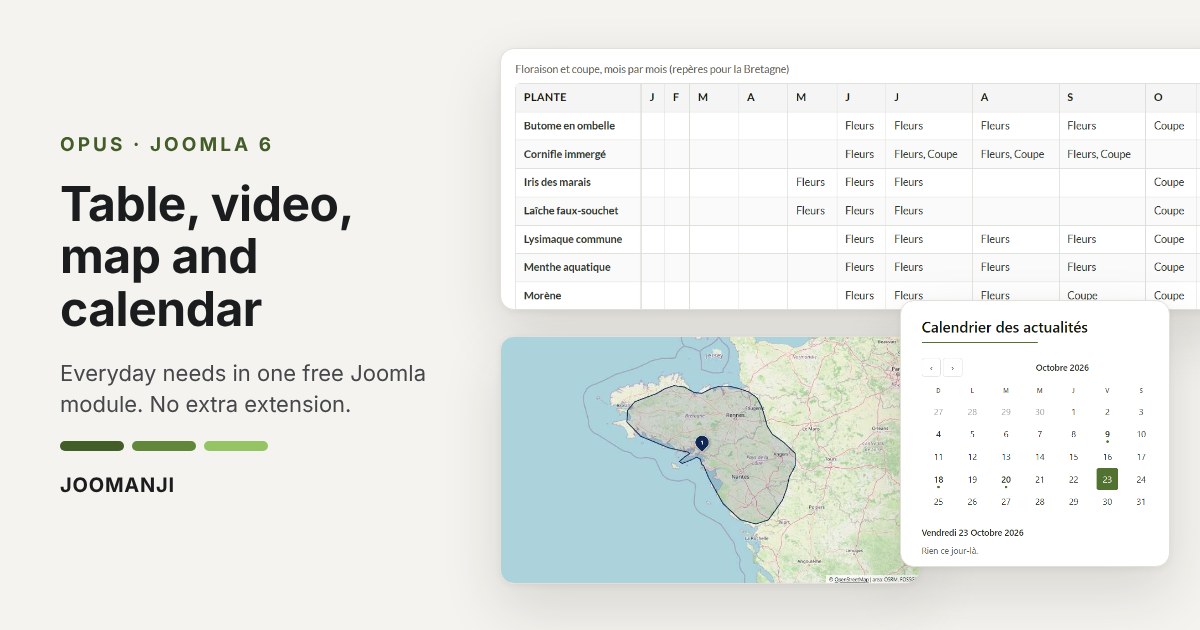
Opus elements welcome four newcomers: the table, the video, the map and the calendar. In one weekend of development, this free Joomla module thus gained what it takes to publish opening hours, a video, a getting-here map or a programme of events, with no extra extension. In addition, every Opus link can now point straight to an article.
Why these Opus elements
First, an observation: these four needs come up on almost every site. However, they often mean installing four different extensions, each with its own interface, scripts and updates. Opus therefore brings them together in the same screen, with the same logic of rows, gears and purple panel. As a result, anyone who can already place a button can also place a map or a calendar.
The table and the video
The table is filled in like a spreadsheet. For example, you copy a range in Excel or LibreOffice, then paste it with Ctrl+V: the grid grows by itself. Next, each row, column or cell has its own settings (background, bold, alignment, total line). The output is a real HTML table, with a caption and headers, as the W3C tables tutorial recommends. On a phone, it switches to readable cards, because the switch follows the width of the block, not of the screen.
The video accepts YouTube, Vimeo, Dailymotion, PeerTube or a file from the site. However, nothing loads before the click on Play: no visitor data goes to the platform, and the page stays light. A transcript and subtitles then complete the picture, for deaf people as well as for search engines.
The map and the calendar
The map runs on OpenStreetMap, with no key to request and no Google account. Places are typed by hand, or they come from the articles of a category with their custom fields. The visitor can then draw a route on foot, by bike or by car, from their position or an address.
The calendar shows a month, a list or a mini calendar for a sidebar. It also reads articles and their Calendar fields. Finally, each card offers "Add to my calendar" for Google, Outlook or an .ics file. Moreover, events are described for search engines, with their date and place.
Opus elements and article links
All Opus elements that carry a link also gain an "An article" type. You pick it in the Joomla selection window, and Opus then respects its access rights and publishing state. In other words, an unpublished article never leaves a dead link behind.
A method for two
Opus is developed by two, Joomanji and an AI, under firm constraints: accessibility, code quality, speed and lightness. Each element was therefore checked on a Joomla 6 test bench, with Cassiopeia as well as with Corpus. Along the way, the administrator was also simplified: the source of places and events is set on the element row, and multiple-choice lists have become plain checkboxes.
Good to know: these elements come with the Opus 1.5.4 series, free on the Joomla Extensions Directory and on joomanji.eu. In the meantime, the online demo already shows what the module can do.